"Green Cyber Demonstration": World Solidarity with the Iranian Protestors
INTERNATIONAL CYBER-DEMONSTRATION IN SUPPORT OF THE IRANIAN PRO-DEMOCRACY MOVEMENT
One aim: unite the world’s citizens of all origins, nationalities and horizons who believe in democracy and Human Rights, and who wish to express their support for the pro-democracy movement in Iran.
This initiative is completely independent, non-political and non-religious.
How to participate
- Join our group on facebook, flickr, add us on twitter & myspace
- make our logo your profile image on these social websites
- write a message of support as your headline & on our page(s)
- inform & send links to your friends & contacts
- write about this event in your blogs & websites, feature our image & add a link to us
- contribute to our webpage with comments, slogans, photos/videos/songs etc.
The pro-democracy protestors in Iran are isolated and vulnerable. A strong turn-out here is a means for us to support them in their battle & remind governments & official international bodies around the world to act in the best interest of these freedom-fighters.Iran has ratified both the Declaration of Human Rights (signed 1948) and the Nuclear Non-Proliferation Treaty (signed 1968). Let us show the world that human dignity and Human Rights are values that transcend frontiers, and that our leaders should use as much energy in defending Human Rights as they do the nuclear issue.
“A dictatorship is more dangerous than a nuclear weapon.”
Context
As a result of the fraudulent Iranian presidential elections of the 12th of June 2009, millions of people took to the streets of Iran to protest against Mahmoud Ahmadinejad; demanding a new and democratic election. These brave protestors, comprising all generations, demonstrated pacifically but faced harsh repression from government forces resulting in beatings, deaths, arrests, torture, forced confessions and mock show-trials. Despite this repression, the protest movement has continued to grow and is known as the ‘Green Movement’ (read below: ‘Why Green?’).In spite of this repression, the pro-democracy protestors in Iran have continued their mobilisation; taking to the streets, infiltrating official marches and finding new means to express themselves such as via the internet - despite the huge risks, including for their lives (two young men arrested before the elections,Reza Ali Zamani and Arash Rahmanipour, were executed on the 28thJanuary 2010, with more feared).
Why Green?
Green is the symbolic colour under which the pro-democracy protestors march in Iran - it is traditionally the colour of hope. Although the colour of the presidential candidate Mussavi in June’s fraudulent elections, the protestors have since made this colour their own and are commonly called the ‘Green Movement’, which has grown to become a spontaneous independent citizen’s movement demanding democracy for Iran. Green is now the colour of all those who march for democracy in Iran.
On the occasion of Norouz, we at World With Iran would like to wish all those in Iran who are repressed and are fighting for their freedom, and those across the world who support them; a very Happy Persian New Year - "Norouz Piruz, Norouz Mobarak!" !نوروز پیروز ~ نوروز مبارک
To say that you are not alone & we as well as others around the world are with you, supporting you in you fight for liberty and justice.
One cannot but help reflect upon this past year, so full of hope for change, so full of sadness for those who have been killed, raped, beaten and imprisoned.
This coming year is going to be decisive in the struggle for those inside Iran who are seeking liberty & the respect of their Human Rights, and our support from outside Iran is vital to continue giving them the strength to go on with this battle in defense of these universal values.
Here are two sets of Videos to reflect upon. The first set are from Norouz this year (the night of the 20th March 2010). The first shows a spontaneous crowd of people who had gathered at the tomb of the great Persian poet, Hafez. At the moment of the New Year, the crowd cries out the name of the opposition leader "Mir Hossein" Mousavi:
The following two videos were filmed on the rooftops of Tehran where the people were protesting against the regime officials by shouting out "Allah-o Akbar" ("God is great"), at the very moment that Ahmadinejad & Khamenei were giving their official Norouz message on Iranian TV:
The last set of videos date from June 2009, the month of the fraudulent elections in Iran after Ahmadinejad had been 'officially' declared the winner. Here we hear the cries from the roofs at night and a woman improvises a poem as she films the scenes. There are subtitles in English.
The first one dates from the night of the 21st June 2009, the second day of the brutal crackdown by the Iranian regime. She speaks of the diversity of the protestors, and of the need to never forget them, their voices & what they have endured:
Finally, this video is a remixed version of another improvised poem by the same woman & dates from the night of Friday the 19th June 2009 - asking "where is this country" where such atrocities take place:
Mir Hussein Moussavi, who claims that he was robbed of victory in last year’s presidential election in Iran by fraud, released his video message to the Iranian peopleon Facebook on Thursday, two days beforethe year 1389 beginson Iran’s calendar. A note posted with the video promises that a complete English translation will be available soon, and includes this excerpt from Mr. Moussavi’s remarks:
The New Year is the year of resistance on these rightful and legal demands, and we do not have the right to give up and back off from these demands as that would be a betrayal to the nation, Islam and the blood of the martyrs. We have achieved this Constitution from the waves of the bloods of many martyrs, and we cannot lose that easily and we all should return to that.
Mr. Moussavi’s popular wife, Zahra Rahnavard, also posted a video message of her own on Facebook page, in which she said:
In this New Year we want to have freedom in our country again. We want the rule of law which one can say that at least it has been 200 or 300 years that human had tried to achieve it would dominate our country. We want the fraud and rumors be eliminated and discrimination in any form, could it be due to financial, class, economical, cultural or women’s affairs would be eliminated.
Ms. Rahnavard’s Facebook page also says that a complete English translation of her remarks will be posted soon.
Copies of both videos were posted on YouTube by the expatriate Iranian blogger Mehdi Saharkhiz, whose father, Isa Saharkhiz, is a political prisoneron a hunger strikein Iran.
TEHRAN (AFP) – Iran's supreme leader Ayatollah Ali Khameneion Sunday urged Iranians to shun next week's Persian fire festival as an un-Islamic event which causes "a lot of harm."
Seven people have already been reported killed in the runup to the festival, ISNA news agency said, quoting a police chief.
Charshanbe Soori, an ancient pagan festival, is held on the eve of the last Wednesday of the Persian calendar year. This year, the ritual falls on the night of March 16.
Khamenei, Iran's all-powerful cleric, said on his website that Charshanbe Soori has "no basis in sharia (Islamic religious law) and creates a lot of harm and corruption, (which is why) it is appropriate to avoid it."
The festival is a prelude to Nowrouz, the Persian New Year which starts on March 21 and marks the arrival of spring.
In the past few years, local municipalities have helped Iranians organise the festival but it is unclear whether they will do so this year in the wake of Khamenei's remarks.
Iranians celebrate the fire festival by lighting bonfires in public places on the night before the last Wednesday and leaping over the flames shouting "Sorkhiye to az man, Zardiye man az to (Give me your redness and I will give you my paleness)."
Leaping over the flames symbolises the wish for happiness in the new year and an end to the sufferings of the past year.
Several casualties are reported from the event every year and many participants suffer burn wounds, including from accidents with firecrackers linked to the event, as they start marking the festivals days in advance.
Iran's deputy police chief Ahmad Reza Radan said that "so far seven people have been reported killed" while making or lighting firecrackers, ISNA reported, adding that most firecrackers are smuggled into Iran.
Some clerics see the ritual as heretical fire worshipping, although it has been marked in Iran for centuries and, like the Persian New Year itself and some other ancient rituals, has survived the advent of Islam.
Perceptions are that supporters of Iranian opposition leaders could use the ritual this year to stage anti-government protests.
Main opposition leader Mir Hossein Mousavi, however, has urged his supporters not to use the event for anti-government rallies and not to provoke hardliners during Charshanbe Soori.
Mohammad Khatami, the soft-spoken former Iranian president who has come under criticism for not being brave enough in his rhetoric and actions, on Monday issued a polite but firmly worded rebuke of the current hard-line establishment.
Khatami's statement appeared to be a response tosupreme leader Ali Khamenei's insistencethat reformists like Khatami had forfeited their ability to participate in the country's political establishment by refusing to accept his divine ratification of last year's presidential elections.
Khatami also filled in some of the blanks in opposition leader Mir-HosseinMousavi's recent interview, forcefully slamming the foreign policy of the government of President Mahmoud Ahmadinejad.
"It is easy to create tensions in the world, but difficult to eliminate them," he said in an account of a meeting with students posted on his charity's website, Baran.org.ir(in Persian). "Detente requires courage and finesse, and the system has to take steps to that effect. We should not embark on adventurism in the world under pretext of having won so many enemies. We should hold back from speaking in a manner to inflict heavy costs."
But, like Mousavi, he failed to articulate a way forward, offering no specific on a course of action other than to say, “We have to mobilize our efforts.”
Khatami insisted on his longstanding position that Iran would each its democratic aspirations if it would only return to the original path of the 1979 revolution charted by Ayatollah Ruhollah Khomeini.
"Everyone may have had his own interpretation of reforms, but we mean reforms within the framework of criteria born out of Islam, the revolution and the nation's will," he said. "In the face of any possible deviation from Islam and Imam Khomeini's line, we have to give warning."
He continued, "Go and ask the former revolutionary militants if the ongoing conditions reflect what they were after. Ask them if these arrests, blame games, vendettas and the imposition of costs on the nation were what the revolutionary forces sought. If not, our conscience necessitates that we close ranks in order to improve conditions."
Though he failed to articulate any course of action, he urged supporters to remain steadfast.
"We should not retreat from our demands, and we should keep fighting even if certain groups beat us on the head," he said. "Unfortunately, certain hard-line groups in the society are opposed to any compromise within the society."
Opposition leader: Dictatorial "cult" rules Iran By ALI AKBAR DAREINI, Associated Press Writer, 27 February 2010,
TEHRAN, Iran (AP) -- Iran's opposition leader said Saturday that a dictatorial ''cult'' was ruling Iran in the name of Islam -- his strongest attack to date on the country's clerical leadership.
Mir Hossein Mousavi also challenged the government to let his supporters take to the streets freely, saying that would allow it to gauge the opposition's true strength. On Thursday, Iran's supreme leader, the Aytollah Ali Khamenei, charged that the country's opposition had lost its credibility and its right to participate in politics by not accepting the results of June's presidential elections. Khamenei's comments suggest that Iran's opposition will be barred from running in any future elections.
''This is the rule of a cult that has hijacked the concept of Iranianism and nationalism,'' Mousavi said in an interview published on his Web site, kaleme.com. ''Our people clearly understand the difference between divine piety and thirst for power in a religious style ... our people can't tolerate that (dictatorial) behaviors are promoted in the name of religion.''
He said the opposition aims to effect reform by raising the consciousness of the Iranian people. ''Spreading awareness is the movement's main strategy,'' he said.
Iran's opposition alleges President Mahmoud Ahmadinejad won the June vote through fraud and that Mousavi was the rightful winner. A massive wave of protests provoked a bloody government crackdown, during which more than 80 demonstrators were killed and hundreds of rights activists, journalists and pro-reform politicians were arrested.
The government, which puts the number of confirmed deaths at 30, has accused opposition leaders of being ''stooges of the West'' and of seeking to topple the ruling system through street protests.
Meanwhile, the country's hardline leaders have put more than 100 people on a mass trial that began in August. Eleven people have been sentenced to death, and more than 80 others have received prison terms ranging from six months to 15 years.
Iran's rulers point to several recent pro-goverment rallies as an indication that the opposition has lost popular backing.
But Mousavi rejected that claim, and accused the state of busing people in to Tehran to inflate the crowds at Feb. 11 celebrations marking the anniversary of Iran's 1979 Islamic revolution.
''It was an engineered rally ... the biggest number of buses and trains were employed for this rally,'' he said. He added that there is ''no pride'' in holding such a rally, and charged that resorting to such tricks is similar to ''a dictatorial mentality and methods employed before the revolution.''
However, Mousavi acknowledged that the government's bloody crackdown has made it impossible for the opposition to publicly engage in political activities.
He urged the clerical leaders to let opposition supporters take to the streets without being attacked by security forces, saying ''how people respond will put an end to all speculation'' about the opposition's strength.
Mousavi also warned that shutting down newspapers and blocking Web sites won't help the ruling system silence opposition voices, and asked that his newspaper be allowed to reopen.
Iran's hardline government has closed down dozens of pro-reform papers, including Mousavi's Kalame Sabz, or Green Word, and blocked hundreds of reformist Web sites as part of its efforts to clamp down on opposition activities.
Despite the government's efforts to control the opposition, Mousavi said repression won't stop people from demanding change.
''Tens of millions of Iranians who face censorship, obstruction of their freedoms and repressive measures ... and the spread of corruption and lies, want changes,'' Mousavi said. ''Repressive measures will distance us from a logical solution.''
Iran's Mousavi Hints At Fresh Protest RFE/RL, 27 Feb 2010.
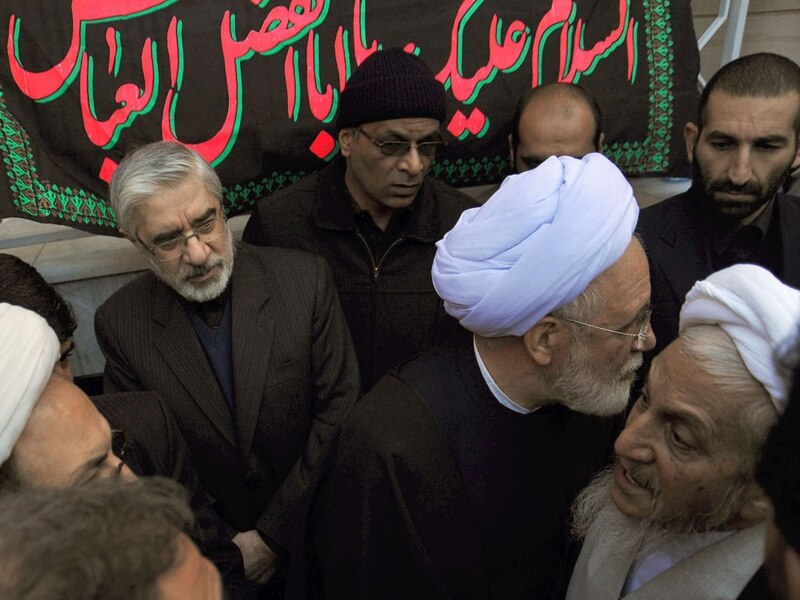
Opposition leaders Mir Hossein Musavi (left) and Mehdi Karrubi (with glasses and white turban) at a funeral procession for Grand Ayatollah Hossein Ali Montazeri in Qom in December.
(RFE/RL) -- Opposition leader Mir Hossein Musavi has urged Iranians to stage a fresh antigovernment rally in the capital, Tehran, in order to highlight the continued strength of his Green Movement.
Musavi's statements, his first extensive comments since opposition street protesters were beaten back with tear gas and police batons on February 11, came in an interview posted to his "Kaleme" website.
He appeared to hint that authorities would not prevent his and fellow opposition leader and cleric Mehdi Karubi's supporters from gathering at an unspecified date.
"I and Mr. Karubi think the Green Movement will be allowed to stage a rally...in order to put an end to all speculation," AFP quoted Musavi as saying in the posting.
Musavi also emphasized the importance of free elections in Iran, according to Radio Farda.
The Islamic republic has seen unprecedented unrest since conservative Mahmud Ahmadinejad was awarded reelection by a landslide in a June presidential election, followed by security roundups and disappearances, mass trials, and a clampdown on dissent and the media.
Musavi on his website warned that he "do[es] not think that such treatment of people will simply be relegated to a memory," according to Radio Farda.
He accused the government of engineering massive pro-regime demonstrations on February 11 in an effort to discredit the opposition.
Musavi condemned the use of government resources -- including buses and trains -- "to gather people for that rally," which marked the 31st anniversary of the Islamic revolution.
Musavi compared it to "the authoritarian mentality and practices before the revolution," under the Pahlavi dynasty, Radio Farda reported.
Opposition leaders had urged their supporters to use that day to demonstrate their continued desire for increased transparency and democratic reform.
The U.S. government is relaxing its limits on the export of Internet technology to Iran. Unless Washington takes further action, though, Tehran's filters might still stop Iranians from accessing critical digital tools.
N. KASHANI and M. SADRA are the pseudonyms of U.S.-based attorneys who are specialists in U.S. export laws regarding Iran.
Last December, the State Department recommended that the U.S. government adjust its sanctions on the export of Internet technology to Iran. This was a major step toward addressing an embarrassing incongruity in U.S. foreign policy. Previously, despite the United States’ espousal of democratic ideals, Congress and multiple administrations had made it illegal for U.S. companies, citizens, or lawful permanent residents to provide Iranian citizens with certain Internet tools, including personal communications programs and anti-filtering software. As the ongoing fallout from Iran’s disputed presidential election last June has shown, such tools are critical in fighting the Iranian regime’s unprecedented campaign of suppressing information and combating political opposition by censoring media, sporadically blocking or slowing the Internet, and intimidating journalists and photographers. The recent shift in U.S. policy, then, is overdue and welcome.
But for this shift to be truly effective, Washington must take further action. This is because, although filter-busting technology exists in Iran, it is hard to come by and often unreliable. Thus some technologies no longer blocked by U.S. sanctions may still remain practically unavailable to Iranians because of Tehran’s filters. Removing sanctions on instant messaging and social-networking software is not enough: to have a concrete effect, the United States must also remove the legal impediments that prevent anti-filtration software from being lawfully exported to Iran.
Iran’s Green Movement, a loosely defined opposition to the ruling establishment, regularly ignores government prohibitions on dissent and uses various outlets to protest governmental corruption, authoritarianism, and opacity. Offline examples include scrawling anti-regime slogans and sarcastic retorts on paper currency and shouting haunting chants of “God is great” from balconies at night. Online, opposition supporters organize rallies through chat rooms and social-networking sites, disseminate videos through YouTube and various other video-sharing sites, and create simple Web sites for posting firsthand accounts of anti-government activism.
Such a reliance on technology should come as no surprise, since Iran has one of the most educated populations in the Middle East. Over 80 percent of Iranians are literate, and more than 25 percent use the Internet (the second-highest percentage in the Middle East, after Israel). And Iranians are proficient adapters of new technologies: Persian (Farsi) is now one of the ten most common languages used worldwide for blogging. This explains why the Iranian government expends great resources on slowing and censoring the Internet -- and why the United States and others should remove sanctions that prevent Iranians from communicating freely, both among themselves and with the outside world.
The State Department’s recent decision means that the Obama administration will now apply broad interpretations to various "exceptions" in the Iranian Transactions Regulations, which date back to 1995.
The State Department’s recent decision means that the Obama administration will now apply broad interpretations to various "exceptions" in the Iranian Transactions Regulations, which date back to 1995 and are promulgated by the Treasury Department. Under this law, the Treasury Department prohibits U.S. persons (defined as companies, citizens, or U.S. residents, regardless of their location) from certain commercial and technological interactions with Iran.
Previously, the Treasury Department’s Office of Foreign Assets Control (OFAC), the entity charged with administering U.S. sanctions on Iran, interpreted the regulations narrowly. Few goods, services, or technologies qualified as exceptions. For example, OFAC interpreted the regulations’ telecommunications exception to allow only telephone calls -- and not the sale of digital communications -- between Iran and the United States. It was thus a crime for U.S. companies to provide Iranians with Internet services, including many that are standard today, such as Web browsers, instant-messaging programs, and social-networking sites. Likewise, the information exception, which allows export of informational content and materials (such as academic publications and artwork), was also narrowly construed by OFAC. This also prevented instant-messaging programs and social-networking technology from being made lawful for export to Iran.
Developments in technology rendered OFAC’s approach grossly outdated, a fact implicitly acknowledged by the State Department’s recent instructions. But the law will still reflect an antiquated view unless OFAC takes additional measures. First, OFAC must issue a general license allowing companies to provide effective technologies to Iran (or invite parties to apply for specific licenses for that purpose). Unless OFAC issues a general license, individuals and nonprofits will still be required to go through the cumbersome and often arbitrary application process currently in place. Second, OFAC must clarify whether the current information exception -- which clearly excludes information itself, such as publications, films, posters, CDs, and other basic media from U.S. sanctions -- also applies to the complementary software used to access it. OFAC’s longstanding interpretation meant that Internet users were free to send information to Iran, but the software needed to access it was technically prohibited. Thus, software and technology companies such as Microsoft and Google had well-founded fears of U.S. government civil or criminal action against them and consequently blocked Iranian users from using their instant-messaging software. As recently as two weeks ago, the open-source software provider SourceForge blocked its software from Iranian users, citing U.S. sanctions concerns as the reason.
Given the unprecedented and potentially fleeting nature of the Green Movement’s strength, it is imperative that OFAC clarify the new State Department directives. First, the Treasury Department could issue a general license for mass-market communications and anti-filtering software. This would not only allow for the export of existing technologies but also support engineers interested in developing technologies for future distribution and purchase. To maintain safeguards over certain sensitive technologies, OFAC and the Treasury Department’s Bureau of Industry and Security could jointly review each application, as they currently do in other contexts, such as in the approval process for the export of medicines and medical devices.
Second, the U.S. Congress should pass the Iranian Digital Empowerment Act. First introduced in December 2009 in the House, IDEA notes that U.S. sanctions on Iran have had the “unintended effect of stifling Iranians’ access to the Internet and related Internet technologies.” The bill authorizes the export of software and services that would ease communication in Iran and allow Iranians to circumvent online censorship and monitoring efforts. It would help assure those companies and individuals that provide messaging services to Iranians that their actions do not violate U.S. law.
At the same time, IDEA is careful not to directly fund such tools or their dissemination to Iran. This is vital, as any direct involvement would feed the paranoia of Iran’s senior leaders about foreign governments fomenting a “velvet revolution.” Giving any legitimacy to that claim plays into the Iranian regime’s hands by granting them circumstantial evidence of foreign meddling when they have thus far been relegated to making bare allegations.
The world has recognized the courageous struggle of Iranian citizens to have their voices heard. The Iranian government, obsessed with maintaining its power at the expense of its citizens' freedoms, will eventually find itself on the wrong side of history. In the months ahead, the United States has the opportunity to restructure its sanctions policies so as to undermine -- rather than unintentionally support -- the Iranian regime’s bankrupt strategy.
The following text is translated from an article written by Armin Arefi in French:
Shocking video which proves the violence used by Iranian police.
This is an exclusive video which the BBC Persian Service has obtained. This is the first and only video to date of the attacks upon the TehranUniversity dorms by the Iranian authorities which date from the 14th of June 2009; two days after the contested presidential elections.
Sunday 14th June 2009 at 9:00pm; the students of the TehranUniversity (the most prestigious and politicised in Iran), decided to gather in protest against the announced re-election of Mahmoud Ahmadinejad, which they considered tainted by mass fraud.
At around 11:30pm; the state security forces which had encircled the university campus, decided to storm the dorms. These forces comprised those of the Special Police (wearing ‘Robocop’ style uniforms), as well as Basij militia men dressed in civilian clothing. One of the assailants filmed the scene with a hand held camera. Warning, this is violent footage:
Iranian law prohibits security forces from entering the TehranUniversity dorms unless the University rector gives permission to do so. Several days later, TehranUniversity’s rector Farhab Rahbar denied any implication in this attack. According to the camera-man’s own statements recorded on the video (at 3min29 into the footage), it was the Tehran police Chief Rasool Azizolah Rajabzadeh, who gave the order to attack. Rajabzadeh has just recently taken his retirement, after only six months at his post.
Clashes brake-out between the two camps and bonfires are lit. Students posted on the roofs of the dorms throw stones onto the security forces below (1min15) while shouting “Resign! Resign!” (They mean the Ahmadinejad government). The security forces also throw stones and tear-gas at the students (1min24).
The Basij militia then attempt to enter the dorms in a rare scene of urban warfare, without success (1min44).
2:30am; the Basij are joined by the Police Special Forces (2min08), still not succeeding in entering the dorms. At this point we notice a man wearing a large light shirt who calls for reinforcements from “children Basij” (2min18).
After many attempts, the security forces manage to break into the dorms section of the university; they are armed with batons (3min17).
The groups of security forces, who have managed to enter the dorms themselves, pull out the students dragging them on the ground (3min44). One of these students receives kicks from a Basij dressed in civil cloths and who orders him to get up (3min48) – though this student no longer appears to present any real threat. In response to this outbreak of extreme violence, even the camera man calls on the Basij to “stop hitting!” (3min51). Students are heard imploring their aggressors; “stop hitting sir!” (3min56)
The assailants then reach the university dorms library building (4min05), from which students are savagely dragged along the ground (4min09), they are beaten and insulted by the Police Special Forces. “Take a picture of him and kill him!” shouts one of the Police while signalling a young man lying on the ground (4min30).
At this point there are half a dozen bodies piled upon each other on the ground surrounded by the Police Special Forces (4min50), who continue to beat and insult their victims:
“Group of f***ers, you wanted to beat us?!?” and “group of faggots, is this what you’re used to?!?” (5min01)
As a mark of how violent the attack by the Special Forces is, members of the Basij militia ask them to stop the violence (5min06):
“Don’t hit him, that’s enough! Stop hitting! Everyone, stop hitting now! Gentlemen, on the soul of Imam Hossein….”
Up till now, the Basij militia (a paramilitary force comprised of young volunteers from the slum quarters who are paid well), especially those in civil dress; were considered to be the most violent section of the security forces and have been blamed as those primarily responsible for the deaths of the opposition protestors, which was not the case for the police. Now a quite different image has been presented to us.
Each new student who has been arrested is thrown onto this pile of bodies (5min34), while the cameraman attempts one again to intercede shouting “don’t hit him!” (6min13)
Then, four police men round upon a student wearing a white shirt (6min17), who quickly collapses from the blows; they continue beating him on the ground (6min20).
There are now a dozen bodies piled-up as though animals (6min40), as blood is dripping from the head of one of them (6min45). The students attempt to protect their heads from the violent beatings, when one of the attackers orders them to:
“Put down your hands now! I’m talking to you!” and “Raise your head! Look at me. Look at me damn it!” (7min29)
The man, of whom we only hear a low voice, takes photos of their distressed faces with his camera (7min35), in order that they be more easily identifiable in the future.
The student political body ‘Tahkim vahdat’ announced the deaths of 5 students on that night, the names of whom The Guardian newspaper listed in an article [read the article here:Iran: 12 students reported killed in crackdown after violent clashes]. The names cited are Fatemeh Barati (a woman), Kasra Sharafi, Mobina Ehterami (another woman), Kambiz Shoaee and Mohsen Imani; the article states that they were buried the following day in a Tehran cemetery without their families having been informed. According to the student website ‘Autnews’, the students had found refuge in the lavatories after the police had stormed the dorms, the rooms of which had been ransacked and the beds set on fire.
The Iranian government denied these reports, talking only of 100 to 120 wounded people. The Supreme Guide Ayatollah Khamenei and Mahmoud Ahmedinejad, as per usual blamed the “enemies” of the Islamic Republic, that is to say foreigners. Before taking to his retirement, the chief of Tehran’s police, Rossool Azizolah Rajab Zadeh, defended his department’s work on that fatefull night.
Eight months later a parliamentary commission had been created to enquire on these events; up till today no conclusion has been made.
The day following these events, with the Iranian authorities assured that they had managed to create an atmosphere of terror among those at the University of Tehran (the bastion of the contestation in Iran), and in an attempt to dissuade people from protesting; millions on Iranians of all sectors of society and age, went onto the streets in silence in order to demand a fair election.
Watch the full length recordings (in higher quality and without the Persian commentary from BBC Persia) in the following two videos:
One aim: unite the world’s citizens of all races, nationalities and horizons who believe in democracy and Human Rights, and who wish to express their support for the pro-democracy movement in Iran.
We are completely independent, non-political and non-religious.